


From Fear to Fear
For someone who has changed houses, cities and countries several times, I know what it feels like to stand at the edge of the unknown.
I have gone through a significant amount of change in my life.
Each time, I experienced the quiet fear that creeps in before you take a leap, even if everything looks exciting on the surface.
I pushed through it, because that’s what growth demanded. But I’ve also had moments of comfort and stability, times when even the thought of moving again felt deeply uncomfortable.
These moments reminded me just how hard it is to change, even when part of you knows it might be necessary.
This personal experience has shaped the way I see the world, especially now, as we collectively face one of the greatest periods of technological and societal transformation in our lifetime.
As a researcher in the fields of neuroscience and leadership, I’ve always been fascinated by how our brains respond to change.
When I observe the current wave of excitement (and anxiety) around Artificial Intelligence, I can’t help but draw parallels with past revolutions that initially sparked fear, but ultimately redefined how we live.
Change has never been comfortable.
Some of the most groundbreaking inventions were first met not with applause, but with anxiety, resistance and even outrage.
Yet, time and time again, society adapts.
We evolve.
We find new ways to work, lead and connect.
We are living in another one of those moments, an inflection point where AI is not just emerging, but rapidly embedding itself into every aspect of how we live, work and think.
So why do we fear innovation so consistently? And what does neuroscience teach us about navigating this new world?
Why The Brain Resists Change
The human brain is an extraordinary organ, evolved for survival. Its primary job is to keep us safe. And what does it perceive as unsafe? The unknown.
When faced with uncertainty, our brain activates the amygdala, the part responsible for detecting threat.
This can trigger a fight, flight or freeze response, even when the “threat” is something as non-lethal as a new piece of software, a different routine or a workplace re-structure.
We also experience the effects of:
- Loss aversion: The fear of losing what we know is often stronger than the excitement of what we might gain.
- Status quo bias: Our brain prefers familiar patterns because they consume less energy.
- Cognitive dissonance: When new technologies challenge our beliefs or professional identity, we feel discomfort and may resist as a result.
In short, innovation creates tension in the brain.
But this tension is also a catalyst for neuroplasticity, the brain’s ability to adapt, learn and grow.
This understanding is supported by the work of authors and researchers such as:
- David Rock, who developed the SCARF model explains social threats and rewards in the brain, especially during change.
- Daniel Goleman, whose research on emotional intelligence shows how self-awareness and regulation are key during uncertainty.
- Dr. Jeffrey Schwartz, who demonstrated how mindfulness and focused attention can reshape neural pathways.
- Lisa Feldman Barrett, who explores how the brain constructs emotions and the role of prediction in human behaviour.
These insights are vital in today’s leadership landscape, helping us understand not just what we fear, but how we can shift from reaction to conscious action.
A Timeline of Fear:
How We Reacted to Revolutionary Inventions
Let’s take a look at some of the most transformative innovations in human history and how they were initially perceived:
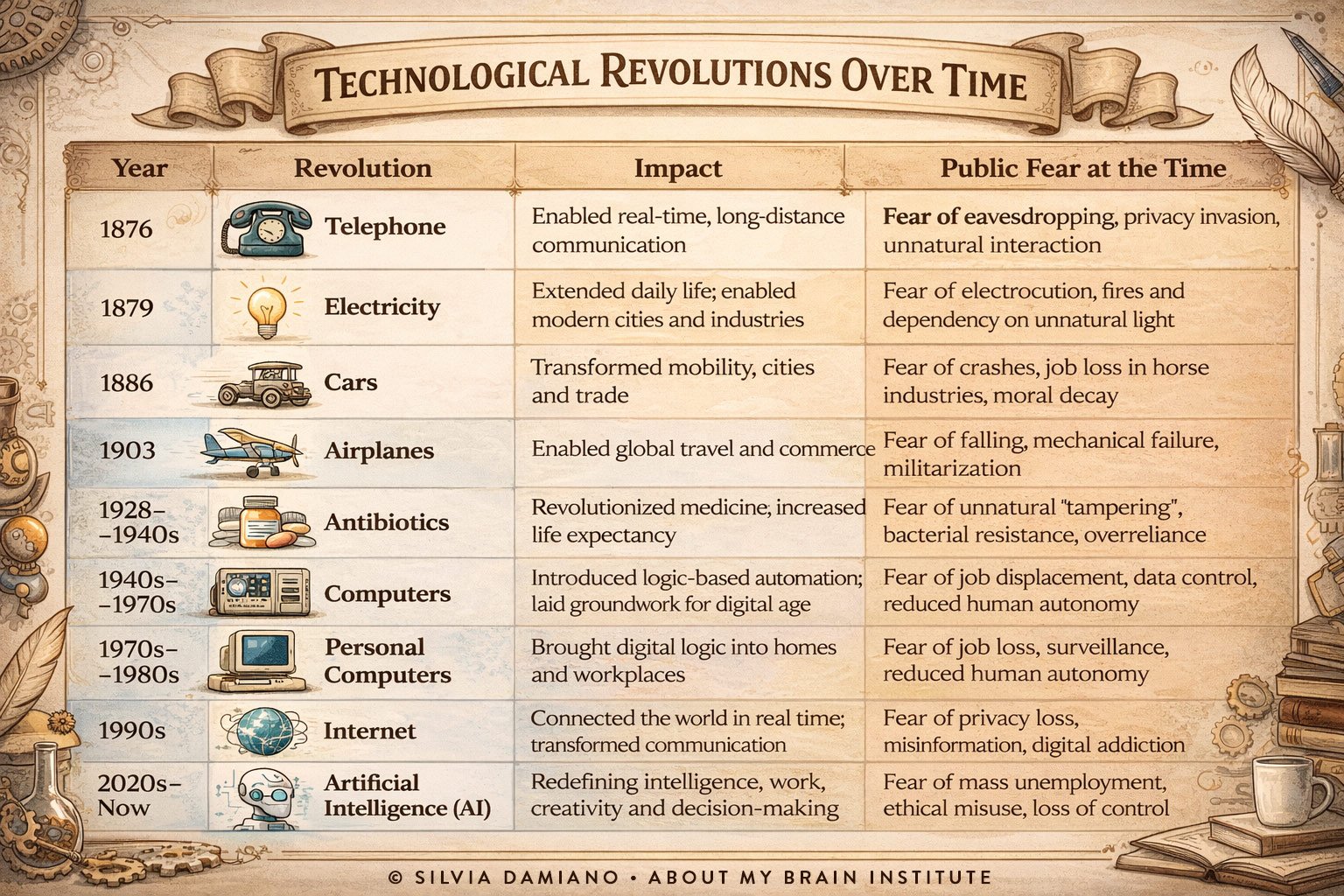
From Threat to Transformation
Each of these technological leaps began with hesitation. Yet in each case, the fear eventually gave way to progress.
We learned.
We adapted.
We evolved.
-
Electricity allowed us to extend our productive hours.
-
The telephone connected our voices across continents.
-
Cars opened up new forms of freedom.
-
Antibiotics saved millions of lives.
-
Computers introduced a new kind of thinking.
-
The internet revolutionised how we communicate and access knowledge.
-
And now, AI is presenting us with the next opportunity, if we choose to engage with it intentionally.
What was once perceived as threatening becomes foundational.
But that transformation doesn’t happen by chance. It happens through brain-based leadership.
It requires us to understand how our minds function under pressure, and how to create environments that allow the prefrontal cortex (our rational, decision-making brain) to lead the way, instead of the amygdala.
What Makes AI Feel Different
Unlike electricity or even the internet, AI feels deeply personal. It doesn’t just change how we move or communicate; it changes how we think, how we make decisions, and how we express creativity.
It challenges the very boundaries of what it means to be human.
This is why emotional agility, imagination, intuition and inspiration are more relevant than ever.
They give us the tools to not just cope with change, but to lead it.
Embracing the Discomfort:
A Leadership Imperative
Progress always begins with resistance.
The discomfort we feel is not a reason to stop; it’s a signal that something transformative is happening.
If we want to remain relevant as leaders, educators and change-makers, we must be willing to navigate this discomfort with curiosity and compassion.
The brain can adapt.
So can we.
Let us not retreat from the fear, but use it as fuel.
Because the truth is:
AI is the next chapter in human evolution.
Let’s design it consciously, with brains and hearts aligned.
A Quote to Remember
Electricity extended our days (1879).
Cars redefined mobility (1886).
Aeroplanes collapsed global distance (1903).
The telephone brought our voices together (1900s). Antibiotics reshaped life expectancy (1940s).
Computers taught us to think in code (1940s–1970s).
The internet connected the world (1990s).
And now, AI is changing how we live, work, create and lead, by designing intelligence itself.
A Gentle Call to Action
If the pace of change feels overwhelming, you are not alone.
Now more than ever, it’s time to pause, reflect, and ask:
How well do I know myself? How am I preparing my mind and heart to lead through change?
Investing in your personal growth is no longer optional; it’s the foundation for sustainable leadership in an AI-driven world.
So start with yourself.
Get curious.
Get intentional because the future doesn’t just happen.
We design it.
Written in the spirit of progress, and the patterns that guide it.

Sources:
- Barrett, L. F. (2017). How emotions are made: The secret life of the brain. Houghton Mifflin Harcourt.
- Goleman, D. (1995). Emotional intelligence: Why it can matter more than IQ. Bantam Books.
- Rock, D. (2008). SCARF: A brain-based model for collaborating with and influencing others. NeuroLeadership Journal, 1(1), 1–9.
- Schwartz, J. M., & Begley, S. (2002). The mind and the brain: Neuroplasticity and the power of mental force. HarperCollins.
No Comments Yet
Let us know what you think