


Compassion isn’t just a poetic idea. It is wired into our biology.
When we see someone in pain, certain regions in the brain light up, allowing us to feel with them. This resonance is the glue of human connection. It is what makes cooperation possible and what holds societies together.
But compassion is fragile. Like a muscle, it strengthens with practice and weakens with neglect. And when greed or unchecked power dominate, empathy and perspective-taking can be silenced.
The Practice of Compassion
Every time we choose empathy over judgment, patience over irritation or generosity over indifference, we strengthen compassion pathways in the brain.
Compassion training has been shown to reshape neural activity, increasing positive emotion and prosocial behaviour.
In leadership, even the smallest gestures: listening without distraction, acknowledging effort, making a fair decision are not trivial. They are neural workouts that shape culture toward connection.
Power and Greed: The Neural Hijack
Power and greed are not abstractions. They are neural events.
The pursuit of power activates the brain’s reward system, flooding the striatum with dopamine.
Greed amplifies this loop, creating an endless craving for “more”, status, wealth, and influence.
The cost is empathy. People in positions of power often engage less in perspective-taking, becoming less sensitive to others.
Keltner calls this the power paradox: the very traits that help us rise; empathy, fairness, generosity often erode once power is secured.
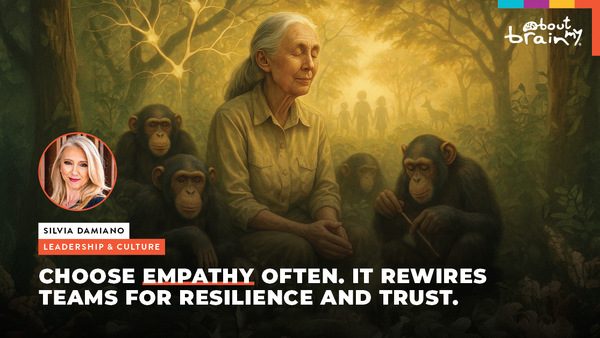
Jane Goodall observed the same tension among chimpanzees. Dominant males who ruled through aggression fractured their communities, while those who paired strength with compassion held power more sustainably.
She also documented striking tenderness, chimps consoling one another or adopting orphans, reminding us that the struggle between compassion and power is as old as evolution itself.
You can read more about this in my other article here.
Protecting Perspective-Shifting
Perspective-shifting: the ability to imagine another person’s experience, engages networks in the prefrontal cortex and temporoparietal junction.
Like compassion, it weakens if ignored.
Practices such as pausing before reacting, seeking diverse conversations, listening fully and reminding ourselves of our blind spots keep this skill alive.
Research shows that perspective-taking not only increases empathy but also reduces bias and aggression.
Encounters With Compassion
While working in South Asia, I once tipped a masseur five times more than I intended.
Minutes later, she and a receptionist appeared on a motorbike, returning the money. “Too much,” she said softly.
I told her to keep it. Tears welled in her eyes.
The most powerful part of that moment was not my giving, but hers; her determination to find me, her refusal to take advantage.
Neuroscience explains why it touched me so deeply: compassion is contagious. When we witness integrity or kindness, our empathy circuits light up.
During my time in Thailand, I also noticed how compassion is woven into daily culture.
People often say mai pen rai: “it’s okay” or “never mind.” On the surface, it sounds casual.
But in practice, it reflects humility and a choice to avoid unnecessary confrontation. Instead of escalating conflict, the phrase preserves harmony. Compassion here is not dramatic; it is quiet grace, expressed through letting go and moving forward without creating wounds.

The Invisible Battle in Our Brains
Every day we fight a silent battle.
On one side are circuits of compassion and perspective-taking; on the other, circuits of power and greed.
Which ones grow depends on what we practice.
But these circuits do more than shape our personal lives.
They also shape the leaders we admire.
If we cannot recognise compassion, honesty, generosity and ability to connect, we will not reward it in others. Instead, we gravitate toward dominance because it feels familiar.
Research supports this. A recent study found that people high in epistemic mistrust (distrusting information from others) and dogmatic thinking (holding rigid, black-and-white beliefs were more likely to prefer authoritarian leaders.
Together, these tendencies create a mindset where power-driven leaders feel safe, because they project certainty in a confusing world.
This dynamic echoes regality theory, which suggests that in times of threat, people favour strong, hierarchical leadership. And according to socio-emotional selectivity theory, as people age, the brain increasingly prioritises familiarity and security over novelty.
That shift can make dominant leaders who promise stability feel especially attractive, even when compassion would serve communities better.
The danger is that arrogant leaders then create a feedback vacuum. People stop offering honest input out of fear.
Silence convinces the leader they are right.
Over time, power dampens empathy circuits and the dopamine reward of dominance reinforces arrogance.
Practical Steps to Keep Power and Greed in Check
-
Pause for reflection. Journaling or mindful breathing interrupts automatic, ego-driven reactions.
-
Anchor in values. Value-affirmation activates self-regulation regions in the prefrontal cortex, reducing selfish impulses.
-
Seek accountability. Surround yourself with people who challenge your blind spots.
-
Practice generosity. Giving activates reward and empathy pathways together.
-
Stay close to the ground. Engage with the real experiences of others so perspective never becomes abstract.
The Leadership Crossroad
Compassion and greed circuits are alive in every brain.
Both grow stronger with repetition.
What we practice daily doesn’t just shape who we are; it shapes the leaders and systems we reward.
If we cannot tell the difference between compassion and greed, we cannot choose wisely. And if we do not practice compassion ourselves, we will not elevate it in others.
Every choice rewires the brain.
Every brain shapes a culture.
Every culture defines a future.
Compassion is not a theory.
It is practice.
If we do not cultivate it, power and greed will gladly take its place.

Sources:
-
Carstensen, L. L. (2006). The influence of a sense of time on human development.
-
Cascio, C. N., O’Donnell, M. B., Tinney, F. J., Lieberman, M. D., Taylor, S. E., Strecher, V. J., & Falk, E. B. (2016). Self-affirmation activates brain systems associated with self-related processing and reward and is reinforced by future orientation.
-
Decety, J., & Lamm, C. (2007). The role of the right temporoparietal junction in social interaction: How low-level computational processes contribute to meta-cognition.
-
Fog, A. (2019). Regality theory: A Darwinian theory of culture and social structure.
-
Galinsky, A. D., Ku, G., & Wang, C. S. (2005). Perspective-taking and self–other overlap: Fostering social bonds and facilitating social coordination.
-
Goodall, J. (1990). Through a window: My thirty years with the chimpanzees of Gombe. Houghton Mifflin.
-
Keltner, D. (2016). The power paradox: How we gain and lose influence. Penguin.
-
Keltner, D., Gruenfeld, D. H., & Anderson, C. (2003). Power, approach, and inhibition.
-
Klimecki, O. M., Leiberg, S., Lamm, C., & Singer, T. (2013). Functional neural plasticity and associated changes in positive affect after compassion training.
-
Moll, J., Krueger, F., Zahn, R., Pardini, M., de Oliveira-Souza, R., & Grafman, J. (2006). Human fronto–mesolimbic networks guide decisions about charitable donation.
-
Sapolsky, R. M. (2017). Behave: The biology of humans at our best and worst. Penguin Press.
-
Singer, T., & Klimecki, O. M. (2014). Empathy and compassion.
-
von Mohr, M., & colleagues. (2025). Epistemic mistrust and dogmatism predict preference for authoritarian-looking leaders.

The Cost Of Control In A World That Wants Freedom

Love, Family And AI: Bridging The Gap Between Human Connection And Technology

No Comments Yet
Let us know what you think