


There was a time when we told our children that if they studied hard, got into university and landed an entry-level job, they’d be on their way to security. That ladder, stable, linear, predictable… is gone.
Today’s emerging professionals are navigating a new kind of challenge. As artificial intelligence begins to replace many entry-level white-collar roles, from analysts to copywriters, some companies are quietly freezing hiring instead of announcing layoffs. This shift is especially impacting recent graduates, many of whom are being pushed toward gig work, solo entrepreneurship or vocational trades.
This isn’t just a hiring issue. It’s a leadership issue.
If I were raising teenagers today (and I have), I would tell them this: Don’t wait for someone to hand you a path. Build a portfolio instead. Develop the mindset to adapt, reimagine and lead yourself, because the world won’t give you a straight line to follow.
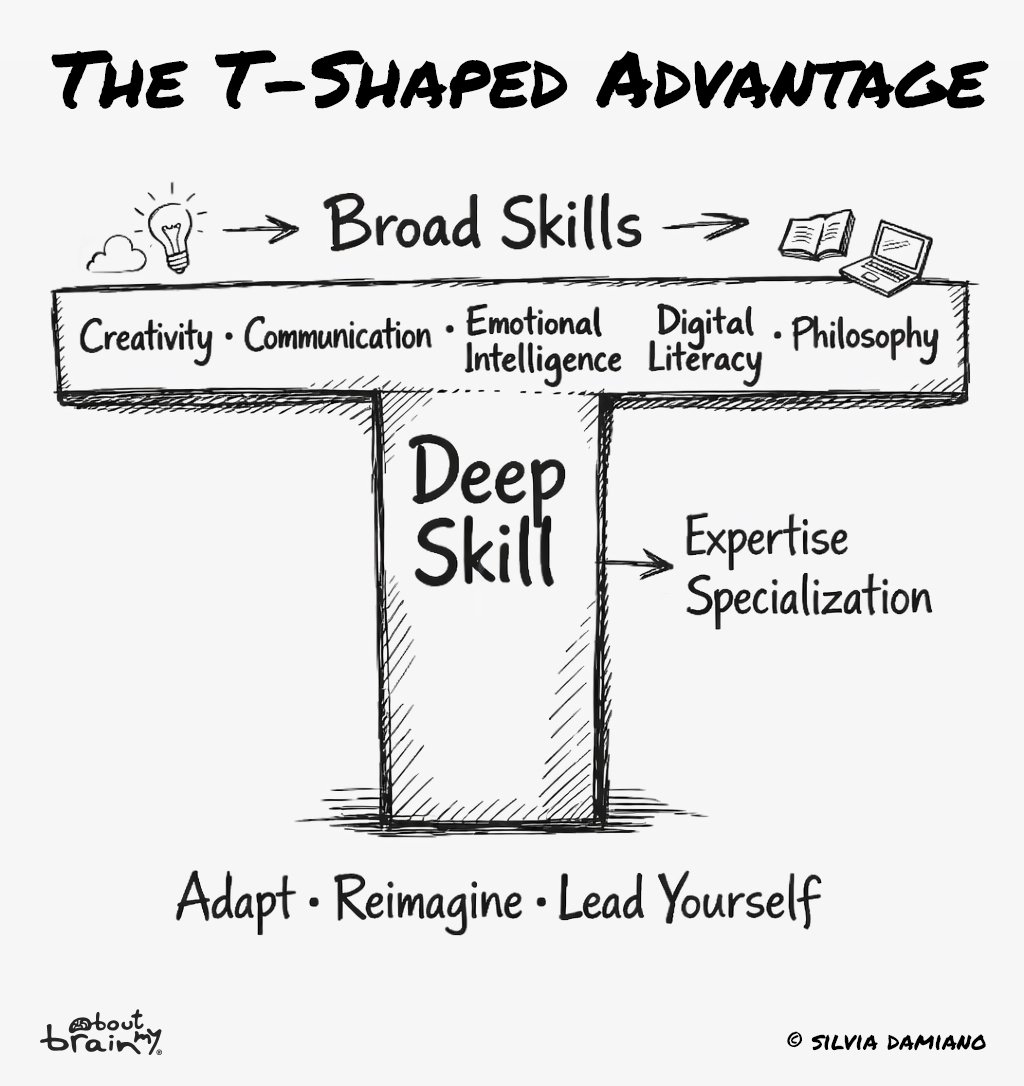
One of the most practical mental models I’ve recommended over the years is the T-shaped approach, popularised by companies like Valve.
Picture it like this:
- The vertical stroke is your deep skill: something you have a talent for or something the market values (ideally both).
- The horizontal stroke is your breadth: creative skills, communication, emotional intelligence, digital literacy and even a healthy dose of philosophy.
You don’t need to become everything. But you do need to think in systems. You need to know how to collaborate across disciplines, adapt your narrative for different audiences and keep learning, always.
Based on recent research, some of the future-ready skills to explore might include:
- AI fluency: prompt engineering, ethical use, understanding automation tools
- Persuasive communication: using storytelling and historical insight to influence positive change
- Synthetic biology awareness: a rapidly growing field with wide implications
- Space entrepreneurship: from satellite tech to space tourism
Alongside these, we must prioritise inner development:
- Learning to lead yourself with care and conviction
- Designing a life with purpose, not just productivity
- Building a nervous system that can hold complexity
As the world shifts from fixed identities to fluid capabilities, leadership is no longer a title. It’s a practice. And it starts with how you respond when no one is watching.
Metrics like IQ or job titles won’t define the next generation of great leaders. Instead, we’ll look for:
- Ability to learn and unlearn quickly
- Capacity to hold opposing truths
- Skill in navigating uncertainty with creativity and compassion
This is the future brain-friendly leadership was built for — where human potential evolves as fast as technology.
So if you’re advising a young adult, mentoring someone just starting out or even questioning your own direction, remember:
You don’t need to climb a ladder that no longer exists.
You can build a bridge.
And walk across it with others who are doing the same.

Sources:
- World Economic Forum. (2023). Future of Jobs Report 2023.
- Valve. (2012). Valve Handbook for New Employees.
- Chen, W. X., & Srinivasan, S. (2024, December). Displacement or complementarity? The labour market impact of generative AI. Harvard Business School Digital, Data, Design Institute.
- Mallett, G. (2025, May 28). AI is already shrinking entry-level tech jobs, study finds. Tech.co.
- Tremayne-Pengelly, A. (2025, September 2). A.I. is eroding the “bottom rungs” of career ladders. Observer.
- Peter, S., Riemer, K., & Norman, P. (2025). The 2026 Skills Horizon. Sydney Executive Plus, The University of Sydney.
How Did The Croods Deal With Change?
The Skills of the Future Are Not What We Think

No Comments Yet
Let us know what you think